history
The History of the Hario V60: A Glassmaker's 2005 Dripper Design
By Home Espresso Bar Editorial Team · November 1, 2026

The Hario V60 is more than a coffee dripper; its development began in a Tokyo laboratory-glass workshop and culminated in a design released in October 2005. By the end of this article you will know who created the V60 and when, why its name reflects both shape and angle, how its signature spiral ribs and single large hole function, what “Hario” literally means, and how a company rooted in heat-proof glass production expanded into specialty coffee equipment, with the V60 spreading worldwide after the 2010 World Brewers Cup. The story weaves together Hario’s early glass-making heritage, a 1980s experiment with cone-shaped drippers, a 2004 redesign collaboration with Arita potters, and the 2005 public launch that set the stage for a global coffee movement.
Key takeaways
- Hario was founded in October 1921 to make laboratory glassware, a heritage that still defines its focus on heat-proof glass today1.
- The “V60” name combines the cone’s V-shape with its 60-degree angle, a geometry chosen for optimal filtration1.
- Spiral ribs inside the cone create an air gap that lets gases escape and guide water flow, while a single large hole gives the brewer precise control over pour speed3.
- After a modest 1980 cone-dripper, Hario’s designers revisited the concept in 2004, working with Arita potters and resin makers to add the ribbed interior that defines the modern V602.
- The V60 was released to the public in October 2005, and its design has remained influential, with the 2025 “20th-year” celebration and the NEO version increasing ribs from 24 to 72 to speed drainage4.
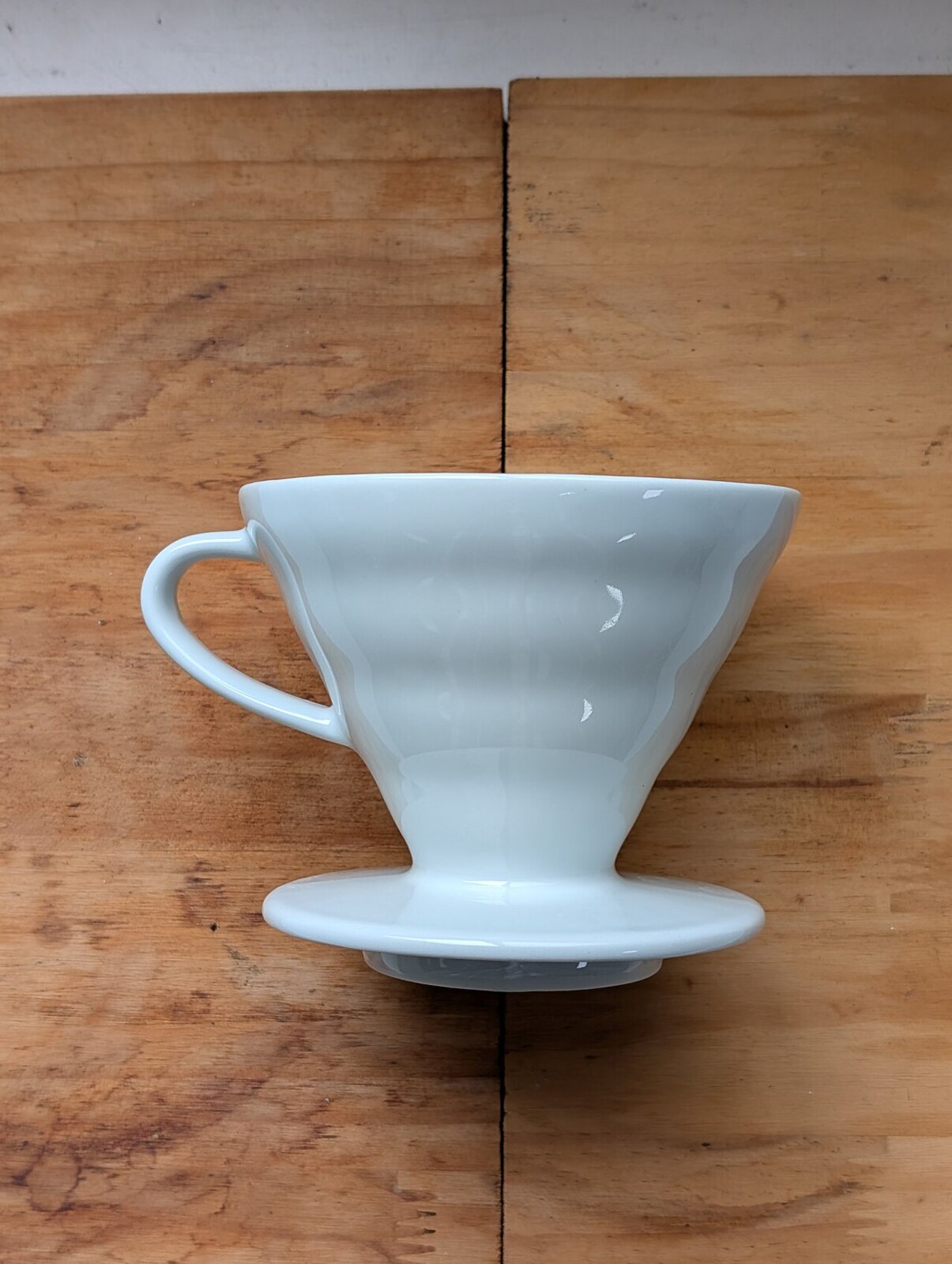
From laboratory glass to coffee gear
Hario’s story starts in October 1921 when founder Hiromu Shibata opened a glass factory in Kanda Sudacho, Tokyo, dedicated to laboratory glassware1. The company name blends the Japanese words hari (glass) and o (king), literally “King of Glass,” reflecting an ambition to become the world’s leading glass maker1. From its inception Hario has specialized in heat-proof glass, remaining the only Japanese manufacturer with its own dedicated factory for that material1.
The glass expertise soon crossed into coffee. In April 1948 Hario introduced the “Hiromu 50,” a household coffee siphon named after its founder, and later the 1967 “Model 70” siphon captured 70 % of the market1. A 1971 breakthrough, a fully electric glass-melting furnace, allowed Hario’s Japanese plant to operate without chimneys, reinforcing its technical edge in glass production1.
These milestones set the stage for Hario’s first foray into pour-over equipment. The company’s global V60 page notes that the original brewing method used an Erlenmeyer-style funnel and a quarter-folded paper filter that Hario already stocked, describing the cone as “the most natural and effective shape for filtration”3. A first personal cone-shaped dripper appeared in 1980, but it struggled to gain traction amid the dominance of instant coffee and electric coffee makers3.


The 2004 redesign: a collaboration that reshaped the dripper
During the 1980s, Japanese cafés favored trapezoid-shaped drippers, prompting Hario’s designers to wonder whether a parabolic shape could deliver a cleaner cup by allowing water to pass through grounds rather than steep them2. The idea resurfaced in 2004 when Hario partnered with resin manufacturers and the historic pottery town of Arita. Their goal was to emulate the nuanced flavor of cloth-filtered coffee, popular in Europe since around 1763, using a conical paper filter that could replicate that taste profile3.
The breakthrough was the addition of spiral ribbing inside the cone. According to Hario’s global description, the ribs hold the paper filter away from the cone wall, creating an air gap that lets gases escape as the grounds expand, while also guiding water flow toward the single large outlet hole3. Standart magazine observes that the glass V60’s “wave-like rib pattern echoes layered molten glass that hardens into a honeycomb-like structure,” linking the visual texture directly to Hario’s glass-making roots4.
The design was finalized after extensive trial and error, and the V60 was released to the public in October 20051. The name itself, V60, derives from the cone’s V-shape and its 60-degree angle, a geometric choice that balances extraction speed with flavor clarity1.
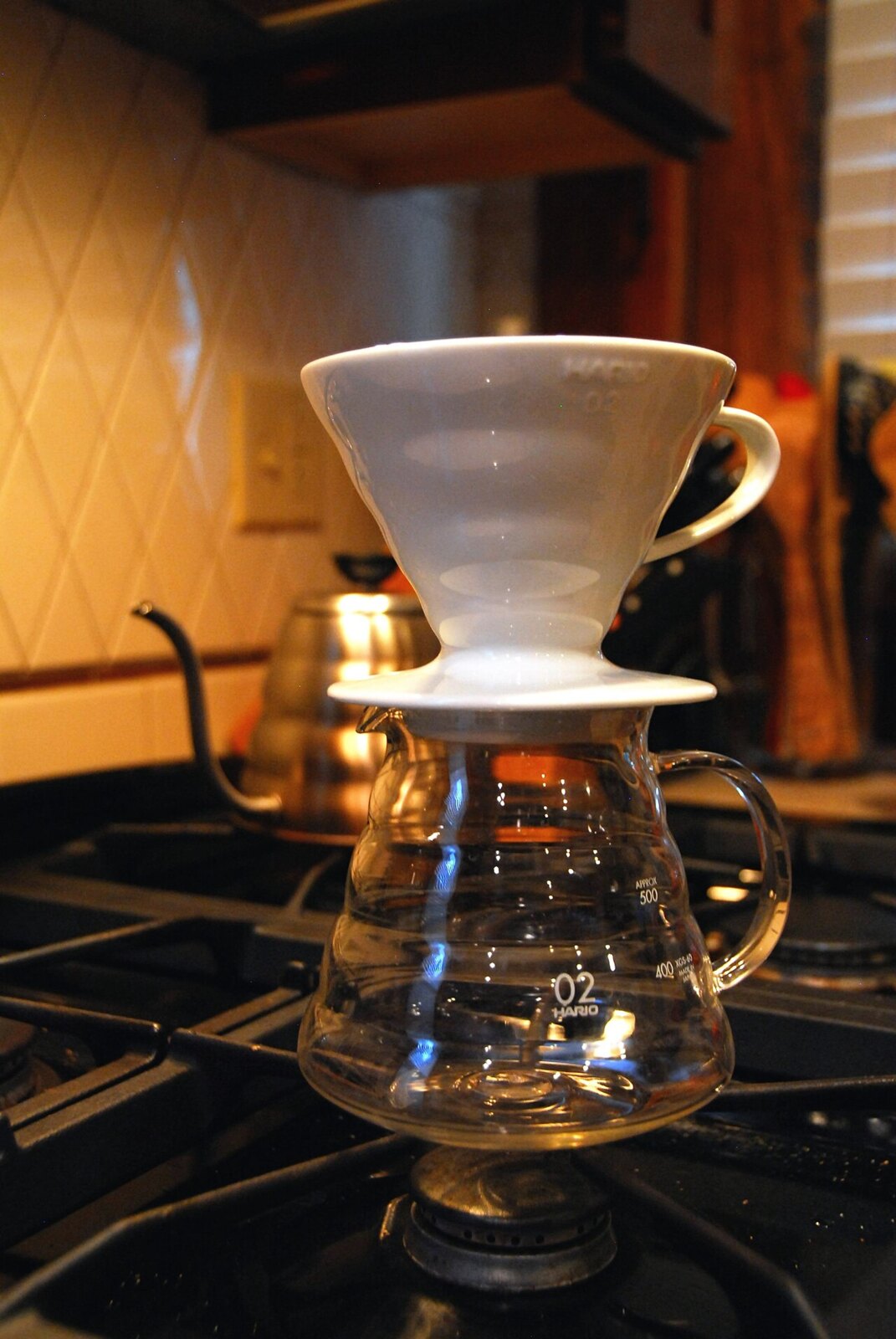
Signature details: ribs, hole, and material diversity
Spiral ribs
The interior ribs are not merely decorative. The ribs hold the paper filter away from the cone wall, creating an air gap that lets gas escape as the grounds expand.
Single large hole
Unlike many drippers that use multiple small perforations, the V60 features one large hole at the bottom. This design places control of the brew rate squarely in the hands of the barista, who can modulate the pour speed and pattern to fine-tune extraction. The single outlet works in concert with the rib-generated air gap, ensuring that water does not rush through the filter but follows a measured path dictated by the pour.
Materials
Hario produces the V60 in plastic, ceramic, heat-proof glass, and metal, extending its aesthetic and functional reach across different brewing environments3. The glass version, with its rib pattern reminiscent of molten glass structures, highlights the company’s heritage, while ceramic and metal variants cater to durability and heat retention preferences.


Adoption and evolution
The V60’s reception was cautious in Japan, where immersion brewing methods dominated the café scene4. Its breakthrough came through the United States’ third-wave coffee movement; Intelligentsia, a pioneering specialty roaster, began lining its bars with the distinctive red V60, showcasing the dripper’s potential for precise, clean cups4.
After the 2010 World Brewers Cup in London, the V60 spread around the world2. By 2025 Hario marked the V60’s 20th anniversary, underscoring its lasting impact on coffee culture4.
The most recent iteration, the V60 NEO, increased the rib count from 24 to 72, a change intended to accelerate drainage and further refine flow control4. This evolution demonstrates how Hario continues to refine the original 2005 concept while preserving its core design philosophy.
Answering common questions
Who invented the Hario V60 and when?
The modern V60 was developed by Hario’s in-house design team, who revisited the conical dripper concept in 2004 and released the finished product to the public in October 200521.
What does V60 mean?
The name combines the dripper’s V-shaped profile with its 60-degree cone angle, a geometry chosen for optimal filtration and flow dynamics1.
Why does the V60 have spiral ribs?
Spiral ribs lift the paper filter away from the cone wall, creating an air gap that lets gases escape as grounds expand and guiding water toward the single outlet, resulting in a cleaner, more controlled extraction3.
Why does the V60 have one large hole?
A single large hole places pour-rate control entirely with the brewer, allowing precise manipulation of flow speed and pattern, which is essential for achieving the desired extraction profile3.
What does the name Hario mean?
”Hario” fuses the Japanese words hari (glass) and o (king), literally “King of Glass,” reflecting the company’s ambition to lead the glass-making world1.
How did a lab-glass company end up making coffee gear?
Hario’s expertise in heat-proof glass, established since its 1921 founding, naturally extended to coffee equipment. Early ventures like the 1948 Hiromu 50 siphon leveraged that glass knowledge, and the 1971 electric furnace further solidified its technical capacity. The 2004 redesign married this glass heritage with coffee-specific design goals, culminating in the V60’s launch in 200512.
Closing thoughts
The Hario V60 stands as a testament to how a company’s core material expertise can inspire a breakthrough in an entirely different domain. From a 1921 laboratory-glass workshop to a 2005 coffee-dripper that influenced the third-wave movement, each design decision, the V-shape, the 60-degree angle, the spiral ribs, and the single large hole, reflects Hario’s glass-making background. The dripper’s evolution, including the rib-dense NEO version, shows a continual refinement that respects the original principles while responding to the needs of modern brewers. As the V60 celebrates two decades of influence, its story reminds us that enduring design often emerges from the intersection of material mastery and a willingness to revisit past ideas with fresh perspective.


