history
The History of the E61 Group Head: Faema's 1961 Design Explained
By Home Espresso Bar Editorial Team · November 1, 2026

The E61 group head is more than a piece of hardware; it is a landmark in espresso-machine engineering that reshaped how baristas control water flow, pressure and temperature. By the end of this article you will understand what makes an E61 group head distinct, how its thermosiphon keeps the brew chamber hot, why the patented cam-driven pre-infusion was a breakthrough, the story of its inventor Ernesto Valente, and why a design born in 1961 still appears in many home espresso machines.
Key takeaways
- Ernesto Valente patented the alternating-valve system in Italy in 1960 and filed a U.S. patent that was granted in 1966, introducing timed pre-infusion to espresso extraction1.
- The hand-turned three-position cam controls two spring-loaded sealing valves and a third valve that feeds a fixed-volume chamber, allowing a low-pressure wetting phase before full 9-bar extraction1.
- A thermosiphon loop circulates hot water from a horizontally mounted boiler through the brass group head, using natural convection to maintain temperature without electronic controls3.
- The massive brass head, weighing several kilograms, provides thermal inertia that steadies brew temperature across consecutive shots2.
- The E61 patent expired in 1996, placing the design in the public domain, and allowing many manufacturers to adopt the same group-head architecture for home machines2.
What is an E61 group head?
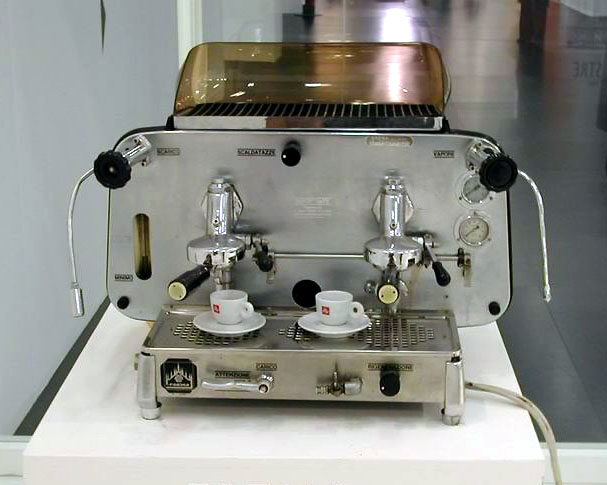
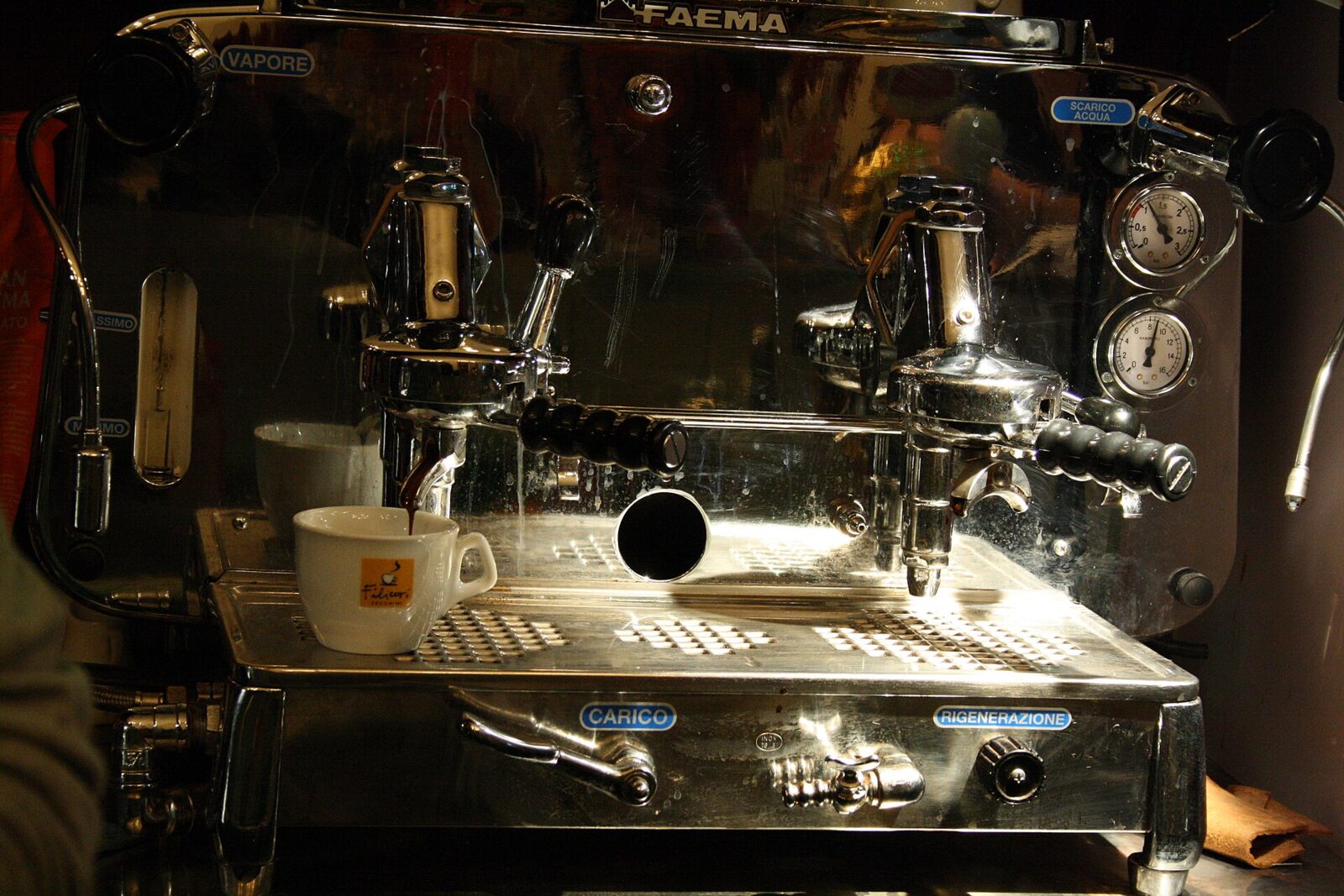
An E61 group head is the brewing interface where hot water meets the coffee puck. Its signature elements are a solid brass housing, a hand-operated cam, and a set of alternately seating valves that manage water flow. The cam rotates through three positions: down (brew valve closed, exhaust open), middle (low-pressure line of about 1-3 bar wets the coffee), and up (full opening for roughly 9 bar extraction)3. The brass construction not only adds durability but, weighing several kilograms, supplies the thermal mass needed to buffer temperature fluctuations during back-to-back shots2.


Thermosiphon: passive temperature regulation
The E61’s temperature stability stems from a thermosiphon loop rather than a pump-driven circulation system. Hot water, being less dense, rises naturally from the horizontally mounted boiler through an inlet pipe into the group head, where it transfers heat to the massive brass body. After giving up its heat, the water cools, becomes denser, and sinks back down a return pipe to the boiler, completing a continuous, pump-free circuit3. This passive convection keeps the brew chamber at a consistent temperature.
Pre-infusion and the cam-driven valve system
Before the E61, many machines forced hot water through the coffee too quickly, limiting the time the grounds could absorb water and extract flavor. Valente’s patent explicitly addresses this by adding a timed pre-infusion phase1. The cam’s middle position opens a small valve that feeds a fixed-volume chamber. As this chamber fills, pressure builds gradually, allowing water at low line pressure (1-3 bar) to wet the puck uniformly. Once the desired pre-infusion time has elapsed, the cam is lifted to the up position, releasing the stored pressure and the full 9 bar pump pressure for extraction1.
Fine-tuning is possible through an adjustable needle valve, spring tension on the sealing valves, and the chamber’s volume, giving baristas control over both infusion timing and pressure profile1. Wikipedia summarizes the effect as “wetting the coffee at low boiler pressure before the 9-bar pump pressure is applied”2.

Design origin and Ernesto Valente
Ernesto Valente of Milan invented the alternating-valve system and filed the Italian patent in 1960. According to Wikipedia, Faema introduced a commercial machine featuring this group head in 1961, and the model name “E61” combines the introduction year with the 1961 solar eclipse. Faema was established in 1945 in Milan by Carlo Ernesto Valente; its name is an Italian acronym meaning roughly “factory of electromechanical and related equipment.” The company had previously built Gaggia’s 1948 espresso machine, but a strategic split occurred when Valente pursued more automated, lower-cost machines while Gaggia remained focused on high-end niche equipment2.
Why the E61 endures in home espresso machines
The expiration of the E61 patent in 1996 placed the entire design in the public domain, allowing any manufacturer to copy the group-head architecture without licensing fees2. Home-brew enthusiasts continue to favor the E61 for several practical reasons. First, the thermosiphon provides stable brewing temperature without the need for electronic PID controllers, simplifying both construction and maintenance3. Second, the mechanical cam and valve system is straightforward to service, with most parts being replaceable by a skilled hobbyist. Third, the manual pre-infusion control offers a tactile, barista-level adjustment that many users find rewarding.
These advantages come with trade-offs. The massive brass head and thermosiphon require a longer heat-up time, often 20 to 30 minutes, to bring the boiler and group to operating temperature, and the design consumes more energy than modern PID-controlled machines3. Nonetheless, the combination of temperature stability, mechanical simplicity, and historic cachet keeps the E61 a default choice for many home espresso machines today.
Frequently asked questions
What is an E61 group head?
It is a brass brewing module that uses a hand-turned three-position cam to control two spring-loaded sealing valves and a third valve feeding a pre-infusion chamber, delivering low-pressure wetting followed by 9 bar extraction3.
What is a thermosiphon and how does it keep the group hot?
A thermosiphon is a passive convection loop where hot, less dense water rises from the boiler into the group head, transfers heat to the brass mass, cools, and then sinks back to the boiler. This circulation maintains a steady brew temperature without a pump3.
What does pre-infusion do, and how did the E61 add it?
Pre-infusion wets the coffee puck at low pressure, allowing the grounds to absorb water evenly before full pressure is applied. The E61 achieves this with a cam-driven valve that fills a fixed-volume chamber, creating a timed low-pressure phase before the 9 bar extraction1.
Why is it called E61?
The name combines the year of the machine’s launch (1961) with the solar eclipse that occurred that year, a naming convention noted in the Wikipedia entry for the model2.
Why do so many home espresso machines still use an E61-style group?
The patent expired in 1996, making the design public domain, and its thermosiphon provides temperature stability without electronics. The mechanical simplicity, ease of repair, and manual pre-infusion control are valued by home users, despite longer heat-up times and higher energy use3.
Who was Ernesto Valente?
Ernesto Valente of Milan invented the alternating-valve system and filed the Italian patent for it in 1960.
Closing thoughts
The E61 group head stands as a testament to clever mechanical engineering solving a fundamental espresso problem: how to give coffee grounds enough time to extract flavor while maintaining precise temperature and pressure. By marrying a cam-driven pre-infusion valve system with a passive thermosiphon loop, Ernesto Valente created a design that was both innovative for its era and resilient enough to become a universal standard. Its public-domain status, combined with the practical benefits of thermal inertia and straightforward mechanics, explains why the E61 remains widely used in home espresso machine architecture more than six decades after its debut.