history
The History of the Bialetti Moka Express: Design of an Icon
By Home Espresso Bar Editorial Team · November 1, 2026

The Moka Express is more than a kitchen gadget; it is a design artifact that has shaped how households brew coffee for almost a century. By the end of this article you will learn about the popular story that Alfonso Bialetti may have drawn inspiration from a laundry-tub observation for the iconic octagonal aluminium pot of 1933, why the shape was patented, how the pump-free mechanism creates coffee at 1-2 bar pressure, and why the design has remained virtually unchanged. You will also see the competing claims over invention, the birth of the mustachioed “l’omino con i baffi” mascot, the post-war advertising push that turned a modest stove-top device into a cultural symbol, and the museum collections that now safeguard its legacy.
Key takeaways
- Alfonso Bialetti introduced the all-aluminium, octagonal Moka Express in 1933; the popular origin story attributes the idea to a laundry-tub principle observed in the 1920s2.
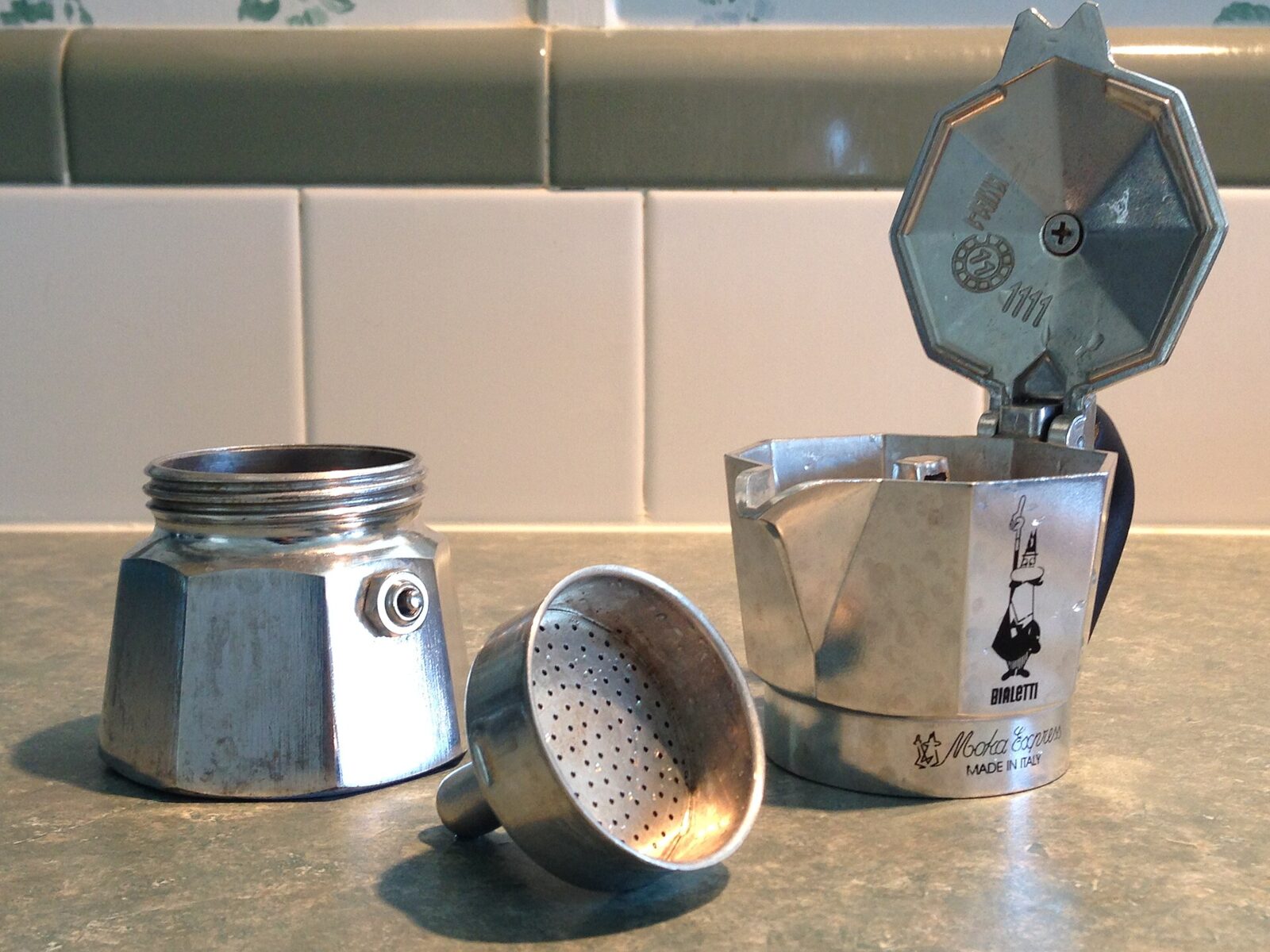
- The pot’s construction, comprising a lower boiler with safety valve, a filter funnel with rubber gasket, and an upper collector, relies on steam pressure of 1 to 2 bar, far below the 9 bar standard for espresso5.
- Aluminium’s thermal conductivity, roughly twenty times that of stainless steel, gives the Moka Express its rapid, even heating and its distinctive Art Deco, die-cast look1.
- While many design histories credit Alfonso Bialetti, some publications note Luigi di Ponti’s involvement in early prototypes, creating a lasting credit dispute.
- The mustachioed mascot, drawn by Paul Campani and commissioned in 1952, has been variously identified as Alfonso or his son Renato, reflecting the family’s central role in the brand’s visual identity5.
- The Moka Express design has been preserved in major institutions such as MoMA, the Smithsonian and the Triennale Design Museum, underscoring its status as a timeless piece of industrial design54.
Mechanism and Materials
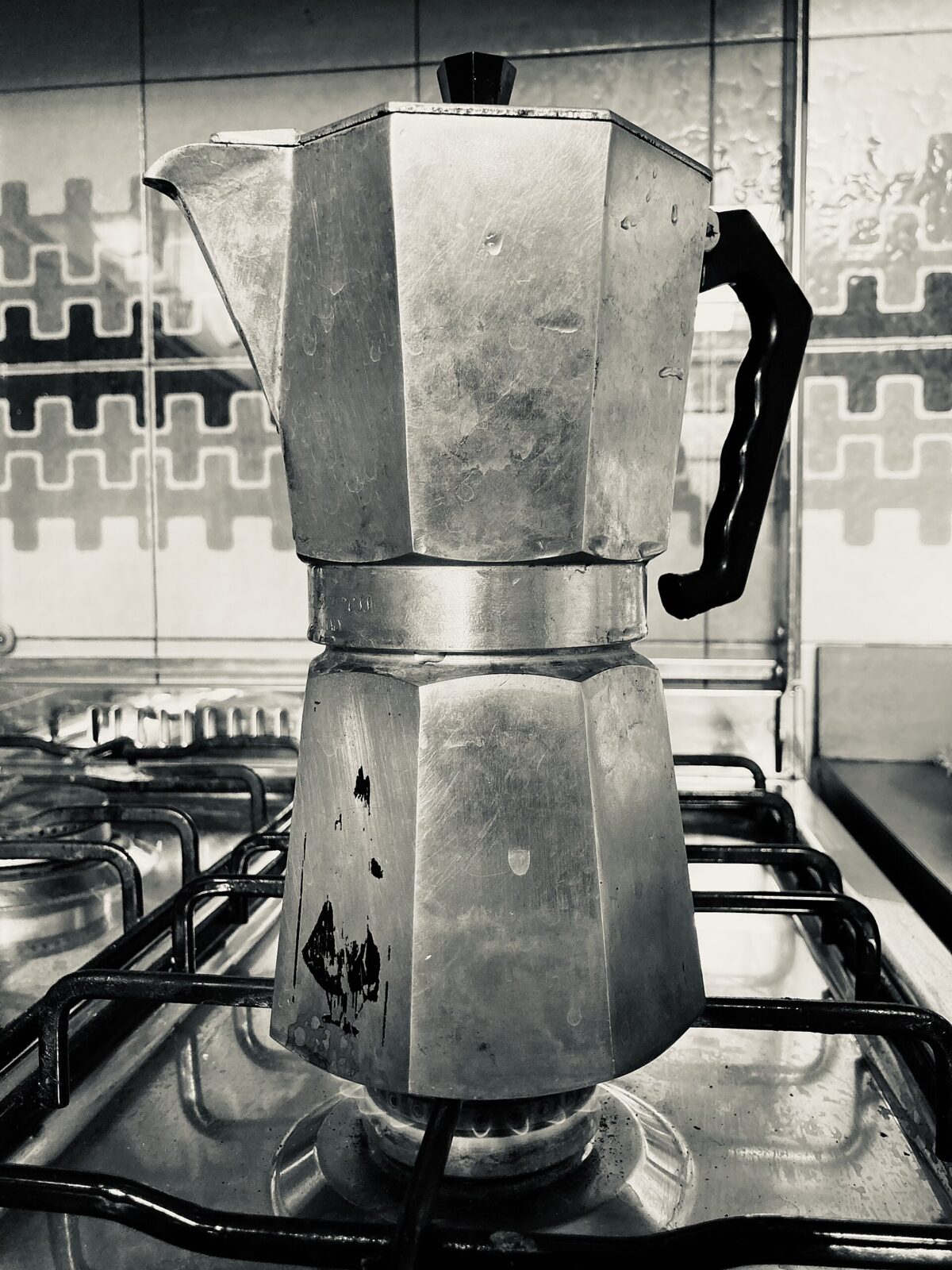
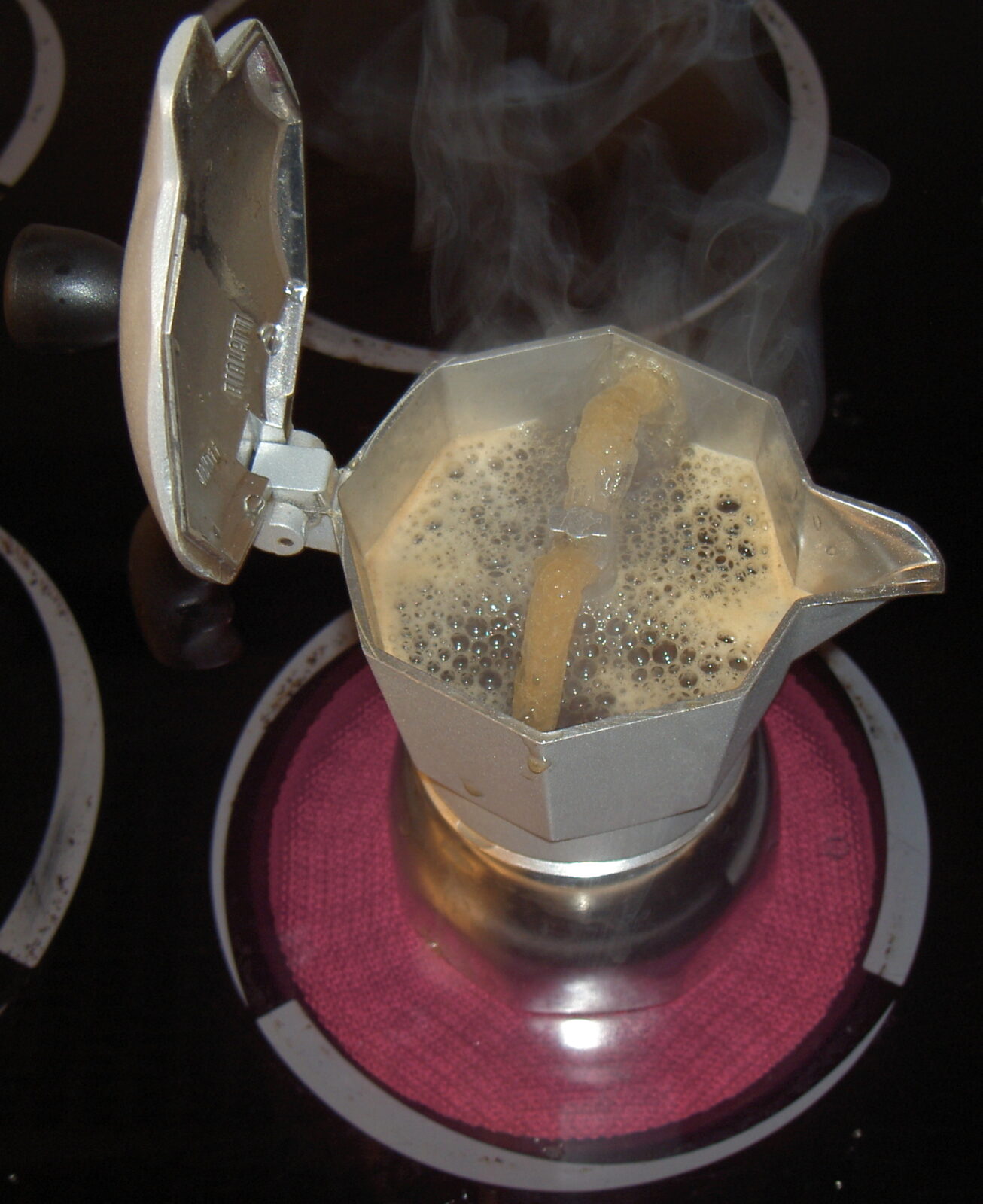
The Moka Express operates on a straightforward steam-driven principle. Water placed in the lower boiler is heated until steam builds pressure; this pressure forces the hot water upward through a perforated filter funnel that holds the coffee grounds, and the brewed coffee then rises into the upper collector. The system is sealed by a rubber gasket and protected by a safety valve on the boiler. Because the pressure generated by the boiling water stays within 1 to 2 bar, the brew is strong but does not meet the 9 bar threshold that defines true espresso5.
Aluminium was a deliberate material choice. Bialetti worked in an aluminium factory in France before founding his own aluminium-goods factory in Omegna-Crusinallo in 1918 (around 1919 per other sources), and the Moka Express is described as die-cast aluminium1. The German Design Council notes that aluminium conducts heat roughly twenty times better than stainless steel, allowing the Moka Express’s thick aluminium walls to heat quickly and evenly1. Early models featured Bakelite handles and a replaceable rubber gasket to maintain the seal5.


Origin Story and Early Design
The legend begins with a domestic chore. In the 1920s, Alfonso Bialetti reportedly watched his wife wringing laundry in a tub that used a central pipe to push hot, soapy water through the clothes. This “laundry-tub” effect sparked the idea of using steam pressure to force water through coffee grounds, a concept later described as a “coffee volcano at home” by the German Design Council2. Translating this observation into a product required a container that could both withstand pressure and conduct heat efficiently, leading Bialetti to adopt aluminium and to shape the pot with an octagonal cross-section. The original patent explicitly required an octagonal body, a detail highlighted both by Il Post and Design Index24.
The resulting Moka Express debuted in 1933 as a stove-top coffee maker. Its Art Deco aesthetic, clean lines, geometric octagon, and aluminium finish reflected contemporary industrial design trends while also serving functional purposes: the facets added rigidity to the aluminium shell and facilitated even heat distribution4.
Credit Controversy
Although many design histories credit Alfonso Bialetti as the sole inventor, the narrative is not unanimous. Core77 references a MoMA and New York Times assessment that attributes the invention to Bialetti, yet it also acknowledges that several publications credit Luigi di Ponti, who reportedly collaborated with Bialetti on early prototypes. Wikipedia’s entry on the moka pot lists Luigi De Ponti only in connection with later milk-frothing patents (Italy 1987, Germany 1984), not with the classic Express design5. The dispute illustrates how industrial collaborations of the early 20th century can blur individual attribution, especially when the resulting product becomes a cultural icon.
Design Evolution and Iconic Branding
Renato Bialetti took over the company in 1946 and ran a large billboard campaign across Italian cities that helped the Moka become a success. In 1956, a giant Moka was installed at the Milan Fair, reinforcing the pot’s status as a national symbol of modern domestic life2.
A key visual element of this branding was the mustachioed “l’omino con i baffi”. Commissioned in 1952, the cartoon figure was drawn by illustrator Paul Campani and appeared in Bialetti ads on the popular TV programme Carosello25. Sources differ on whether the character represents Alfonso or Renato; the German Design Council leans toward Renato, while other accounts suggest Alfonso5.
Despite decades of mass production, the Moka Express’s core design has remained unchanged since its 1933 debut, a claim affirmed by the company itself and echoed in Wikipedia’s overview5. The durability of the design can be attributed to its functional clarity: the octagonal aluminium body, the brewing system, and the Bakelite handle together deliver a reliable coffee experience without superfluous ornamentation. The pot’s status as a design classic is reinforced by its inclusion in prestigious collections such as the Museum of Modern Art (MoMA), the Smithsonian Institution, the Cooper-Hewitt, the Design Museum in London, the Wolfsonian-FIU, and the Triennale Design Museum in Milan54. Even contemporary designers have referenced the form; Gaetano Pesce’s 1993 “Vesuvio” pot playfully re-imagines the moka principle as a volcano, underscoring the original’s iconic silhouette1.
Core77 reports that Renato Bialetti died in February 2016 aged 93 and was buried, at his own request, in an urn shaped like an oversized Moka Express.
Answering Common Questions
Who invented the moka pot, Alfonso Bialetti or Luigi De Ponti?
The predominant historical record credits Alfonso Bialetti. However, some sources acknowledge Luigi di Ponti’s involvement in early prototype development, leading to a lingering credit dispute5.
Why is the Moka Express octagonal?
The original patent specified an exclusively octagonal shape for the pot. The facets add rigidity to the aluminium shell and align with the Art Deco geometric language of the early 1930s24.
How does a moka pot work without an electric pump?
Steam generated in the lower boiler creates pressure of about 1 to 2 bar, which forces hot water up through the coffee grounds in the filter funnel. The brewed coffee then collects in the upper chamber, all without any electric pump5.
Is moka coffee espresso?
No. Espresso is defined by a brewing pressure of 9 bar, whereas the Moka Express operates at 1 to 2 bar. Consequently, moka coffee is strong and concentrated but does not meet the technical definition of espresso5.
Who is the mustachioed man on the Bialetti logo?
The cartoon figure, known as “l’omino con i baffi,” was drawn by Paul Campani and was commissioned in 1952, later appearing in Bialetti ads on the Italian TV programme Carosello. Sources differ on whether the character depicts Alfonso or his son Renato; the German Design Council leans toward Renato, while other accounts suggest Alfonso5.
Why has the Moka Express design barely changed since 1933?
Its enduring form combines functional efficiency with a timeless aesthetic. The octagonal aluminium body, the brewing system, and the Bakelite handle together deliver reliable performance, making redesign unnecessary. The design’s inclusion in major museum collections further reinforces its status as a completed work of industrial design54.
Closing Thoughts
The Moka Express stands at the intersection of everyday utility and celebrated design. The popular origin story links a laundry-tub observation, the choice of aluminium for rapid heat transfer, and the octagonal patent to Alfonso Bialetti’s inventive mindset, even if the exact credit remains partially contested. Renato Bialetti’s post-war marketing, the iconic mustachioed mascot, and the pot’s steadfast visual language transformed a functional stove-top device into a cultural emblem that still appears unchanged in museum halls worldwide. As a result, the Moka Express continues to brew not only coffee but also a narrative of industrial ingenuity, family legacy, and timeless design.