history
The History of Gaggia: How a Milan Lever Created Espresso Crema
By Home Espresso Bar Editorial Team · November 1, 2026

Achille Gaggia’s name is inseparable from the modern espresso cup, yet most coffee-enthusiasts only glimpse the final product without seeing the engineering milestones that made crema possible. By the end of this article you will know exactly how a 1938 steam-less pressure patent, a 1947 spring-lever piston invention, and the 1991 Gaggia Classic each reshaped espresso design, why the 1938 patent did not involve a lever, how mechanical pressure replaced steam, and what makes the Classic’s stainless-steel silhouette a lasting reference point for today’s baristas and home brewers alike.
Key takeaways
- In 1938 Achille Gaggia filed Italian patent no. 365726 for the “Sistema Lampo,” a pressurised-water group that generated natural crema2.
- The 1947 spring-lever piston patent introduced a mechanically driven high-pressure brew (8-10 bar) that could pull a shot in roughly 25-30 seconds, eliminating steam as the pressure source15.
- The 1991 Gaggia Classic launched as a manual espresso machine with a stainless-steel body and a simple, modern design; it was initially marketed as “Classic Coffee,” and Gaggia reports it remained a bestseller for more than 30 years34.
- Gaggia’s early commercial focus shifted to the domestic market, with the Baby Gaggia credited as the start of mass-produced home espresso machines3 and the Modello 80 launching in 19751.
- The lever-based design dominated espresso engineering until Faema’s E-61 pump system appeared, but Gaggia’s patents laid the mechanical foundation for both professional and home espresso makers6.
The 1938 Lampo Patent: Steam-less Pressure and the First Crema
Achille Gaggia began his coffee career behind the counter of his family’s Milan café, Caffè Achille on Viale Premuda, around 19302. Observing the limitations of steam-driven machines, he filed Italian patent no. 365726 on 5 September 1938 for the “Sistema Lampo.” Unlike contemporary brewers that forced steam through the coffee puck, the Lampo system pumped hot water under pressure, a concept Gaggia’s own heritage page describes as “pressurised hot water instead of steam”2.
The brand credits this steam-less approach with producing the natural, golden crema that became the hallmark of Italian espresso2. The Lampo group debuted publicly at the Milan Trade Fair in 1939, where bar owners quickly realised that retrofitting existing machines was impractical. Gaggia responded by assembling complete espresso units with the Lampo group already installed2.


The 1947 Spring-Lever Piston: Mechanical Pressure Before the Pump
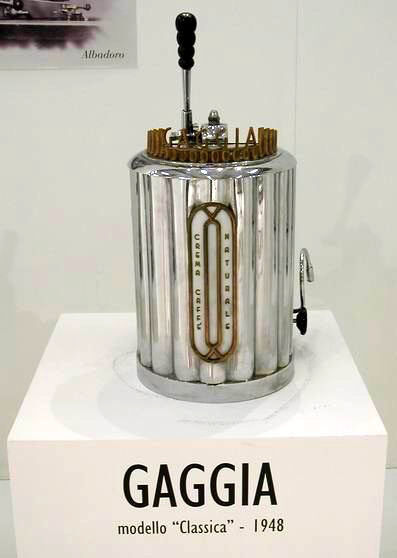
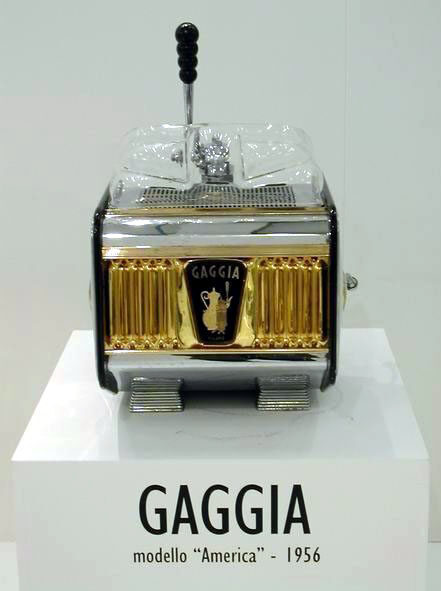
A decade after the Lampo breakthrough, Gaggia filed a second patent in 1947 that described a spring-lever piston system2. In this design, the barista pulls a lever that compresses a spring; the stored energy then drives a piston forward, forcing hot water through the coffee at high pressure. Gaggia’s own narrative notes that this mechanism could extract an espresso in roughly 25 to 30 seconds1.
The Google Arts & Culture exhibit confirms that the lever machine achieved pressures between 8 and 10 bar and produced the characteristic crema5. By replacing steam with mechanically generated pressure, the lever machine broke from the steam-driven tradition. The higher, more consistent pressure not only shortened extraction time but also produced a richer, more stable crema, cementing the lever design as the industry standard until the advent of pump-based systems.
Wikipedia’s entry on the E-61 pump notes that Gaggia’s spring-lever design was the dominant espresso architecture before Faema introduced its pump-driven model, and that Faema even built Gaggia’s 1948 machine before the two companies diverged over target markets6. This context underscores how Gaggia’s 1947 patent defined professional espresso engineering.
1991 Gaggia Classic: A Modern Take on a Historic Mechanism
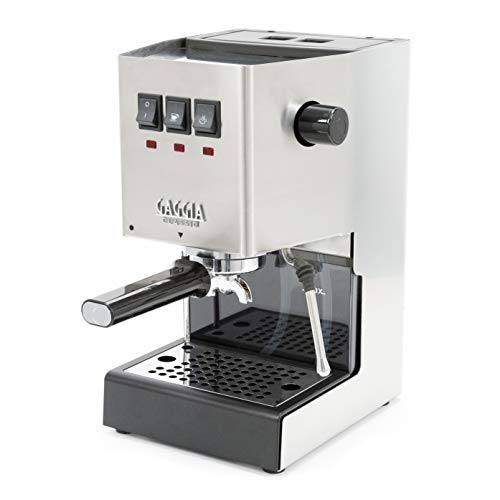
Gaggia introduced the Classic in 1991 as a manual espresso machine with a stainless-steel body and a simple, modern design3. Wikipedia records that the model was initially marketed as “Classic Coffee,” reinforcing its positioning as a bridge between professional technique and home convenience4.


Answering Common Questions
Who invented crema, and when?
Achille Gaggia’s 1938 Lampo system is credited by the brand itself with producing the natural layer of crema that defines espresso.
Was the 1938 Gaggia patent a lever machine?
No. The 1938 patent (Italian no. 365726) described a steam-less, pressurised-water group, not a lever-driven mechanism2.
How did the spring lever create pressure without an electric pump?
The 1947 patent introduced a spring-loaded lever that, when pulled, compresses a spring. Releasing the lever lets the spring drive a piston forward, forcing hot water through the coffee at 8-10 bar, purely mechanical pressure, independent of any electric pump25.
Why was the 1947 lever machine a break from steam-driven espresso?
Steam-driven machines relied on the expansion of water vapor, which limited pressure. The 1947 lever design generated higher, controllable pressure (up to 10 bar) through mechanical force, enabling faster extraction (25-30 seconds) and consistent crema, features unattainable with steam alone15.
When did the Gaggia Classic launch and what was distinctive about its design?
The Classic launched in 1991 as a manual espresso machine with a stainless-steel body and a simple, modern aesthetic. It was marketed as “Classic Coffee”34.
Did Gaggia invent the home espresso machine?
Gaggia’s first commercial machines were professional-grade, but the brand soon expanded into the domestic market. Wikipedia notes that the Gilda was the first home machine released shortly after the initial commercial models, and that production of home machines grew in 19774. Gaggia’s own page highlights the Baby Gaggia as the start of mass-produced home espresso machines, though it does not specify a launch year3. Thus, while Gaggia was a pioneering force in bringing lever-based espresso to households, it was not the sole inventor of the home espresso machine.
Why the Gaggia Milestones Matter Today
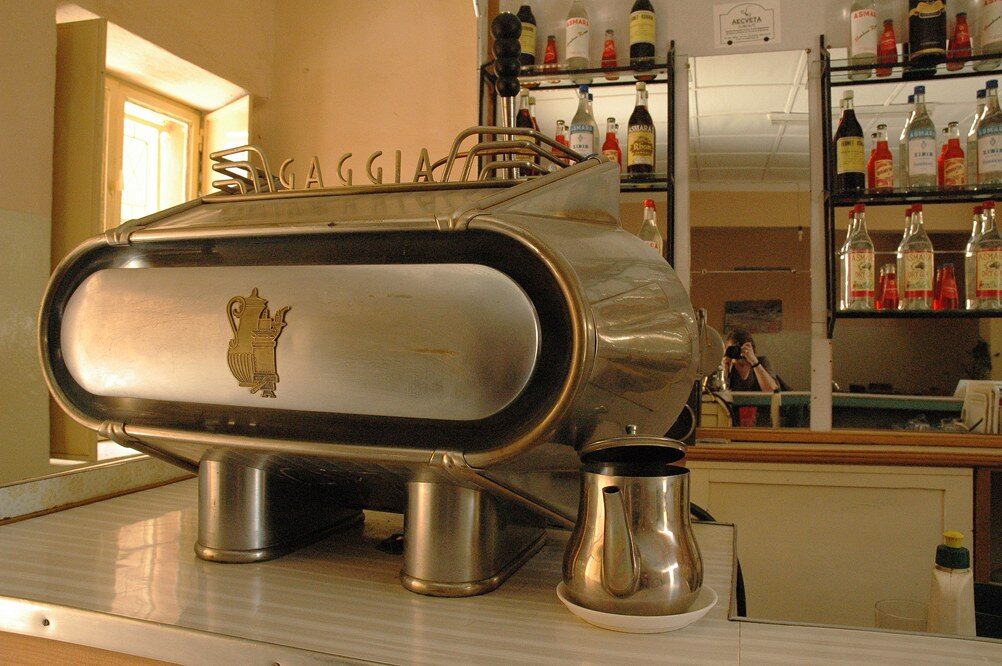
The three milestones explored here, 1938’s steam-less Lampo group, 1947’s spring-lever piston, and 1991’s Classic, form a coherent narrative of design evolution. Each addressed a specific limitation of its predecessor: Lampo solved the lack of crema, the lever piston delivered consistent high pressure without steam, and the Classic translated that mechanical heritage into a durable, user-friendly form for modern kitchens.
Even as pump-driven and super-automatic machines dominate the market, the lever-based approach remains a benchmark for baristas who value tactile control and the visual drama of pulling a shot by hand. Gaggia’s ability to adapt a historic mechanism into a contemporary stainless-steel silhouette explains why the Classic continues to be referenced in design discussions and why newer iterations like the Classic Pro (2019) and Classic Pro Evo (2023) still echo the original’s proportions4.
Understanding these turning points not only clarifies the technical lineage of espresso machines but also highlights how a single designer’s vision, rooted in a Milanese coffee shop, shaped an entire industry’s standards for pressure, crema, and ergonomics.